About 35 min one-to-one, or 45 min with a small group
1. Warm up (5 to 10 min): Ask the quick questions with notes closed.
2. Teach: Work through the lesson slides in order.
3. Coach practice: Use the student examples and try-it tasks.
4. Check: Finish with the outcome prompts below.
Warm-up questions
Name a molecular substance tutors used today.Listen for: For example, sugar, water, rubbing alcohol or plastic. Listen for variety.
What makes a plastic bag a polymer?Listen for: It is made of long chains of repeating units. Any mention of repeating chains is good.
If tutors wanted to test which wax melts first, what would tutors keep the same?Listen for: The heat source, sample size and starting temperature. This checks fair testing.
What to check they understood
20-A2.1s
Ask them to plan a safe test of melting points for two molecular solids, naming the manipulated, responding and controlled variables.
A strong answer names the type of solid as manipulated, the melting temperature as responding, and sample mass and heat source as controlled, and starts by reading the labels and safety sheets.
20-A2.1sts
Ask them to describe one way nanotechnology or polymer science uses knowledge of molecules.
A strong answer names an example such as stain-resistant fabric or plastic packaging and explains how designing the molecule's shape or chains gives the product its property.
Likely gaps from earlier grades
Students sometimes call a salt crystal a polymer. A polymer is a long chain of linked molecules.
Class slides
Work through the class slides
1 / 6
Sugar and a cleaner share a pattern
Table sugar is sucrose, formula C₁₂H₂₂O₁₁, a molecular solid in food.
Some cleaners use ethanol, C₂H₆O, a small molecular liquid.
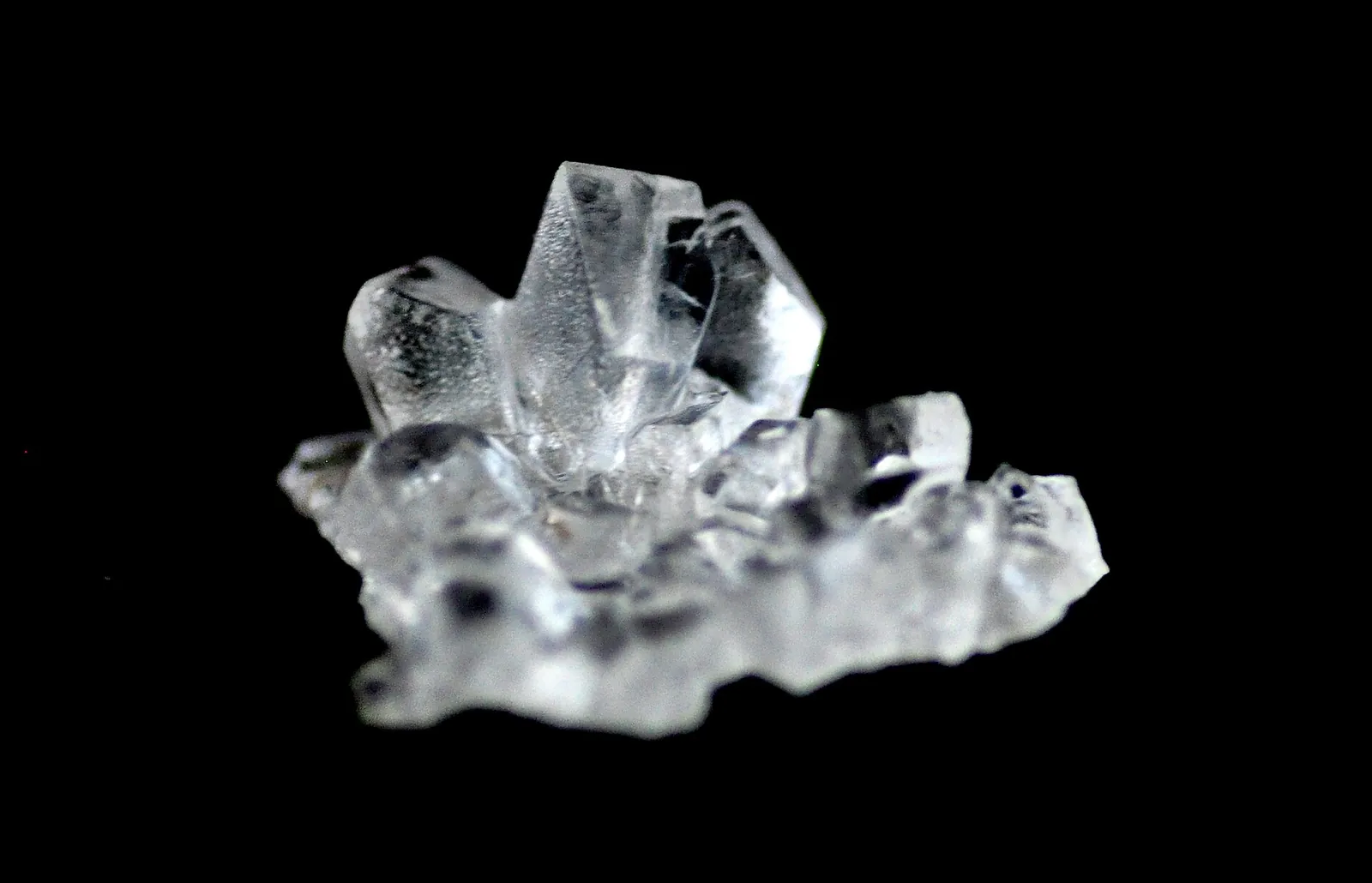
Large crystals of table sugar, sucrose, C₁₂H₂₂O₁₁. Each crystal is a stack of whole sucrose molecules held together by forces between molecules. Those forces are weaker than ionic bonds, so sugar melts at a much lower temperature than salt.