About 35 min one-to-one, or 40 min with a small group
1. Warm up (5 to 10 min): Ask the quick questions with notes closed.
2. Teach: Work through the lesson slides in order.
3. Coach practice: Use the student examples and try-it tasks.
4. Check: Finish with the outcome prompts below.
Warm-up questions
A pH of 3 and a pH of 4: which is more acidic, and by how much?Listen for: The pH 3 solution, ten times more acidic. Listen for the factor of ten.
What pH is pure water at room temperature?Listen for: It is 7. This sets the neutral reference point.
If tutors know the pH, how could tutors find the pOH?Listen for: Subtract from 14. This checks the relationship.
What to check they understood
20-C2.3k
Ask them to calculate the pH of a solution with a hydronium concentration of 6.3 × 10⁻⁴ mol/L, with the right number of decimal places.
A strong answer finds pH 3.20, and explains that two significant digits in the concentration give two decimal places in the pH.
20-C2.5k
Ask them to find the hydroxide concentration of a solution with pH 9.50.
A strong answer finds pOH 4.50 by subtracting from 14.00, then takes ten to the negative 4.50 to get 3.2 × 10⁻⁵ mol/L.
Likely gaps from earlier grades
Students often count every digit in a pH value as significant. Only the digits after the decimal point count.
Class slides
Work through the class slides
1 / 6
Significant digits in meter readings
pH 3.20 comes from a hydronium concentration of 6.3 × 10⁻⁴ mol·L⁻¹.
The SI unit on that concentration is mol·L⁻¹, moles of solute per litre of solution.
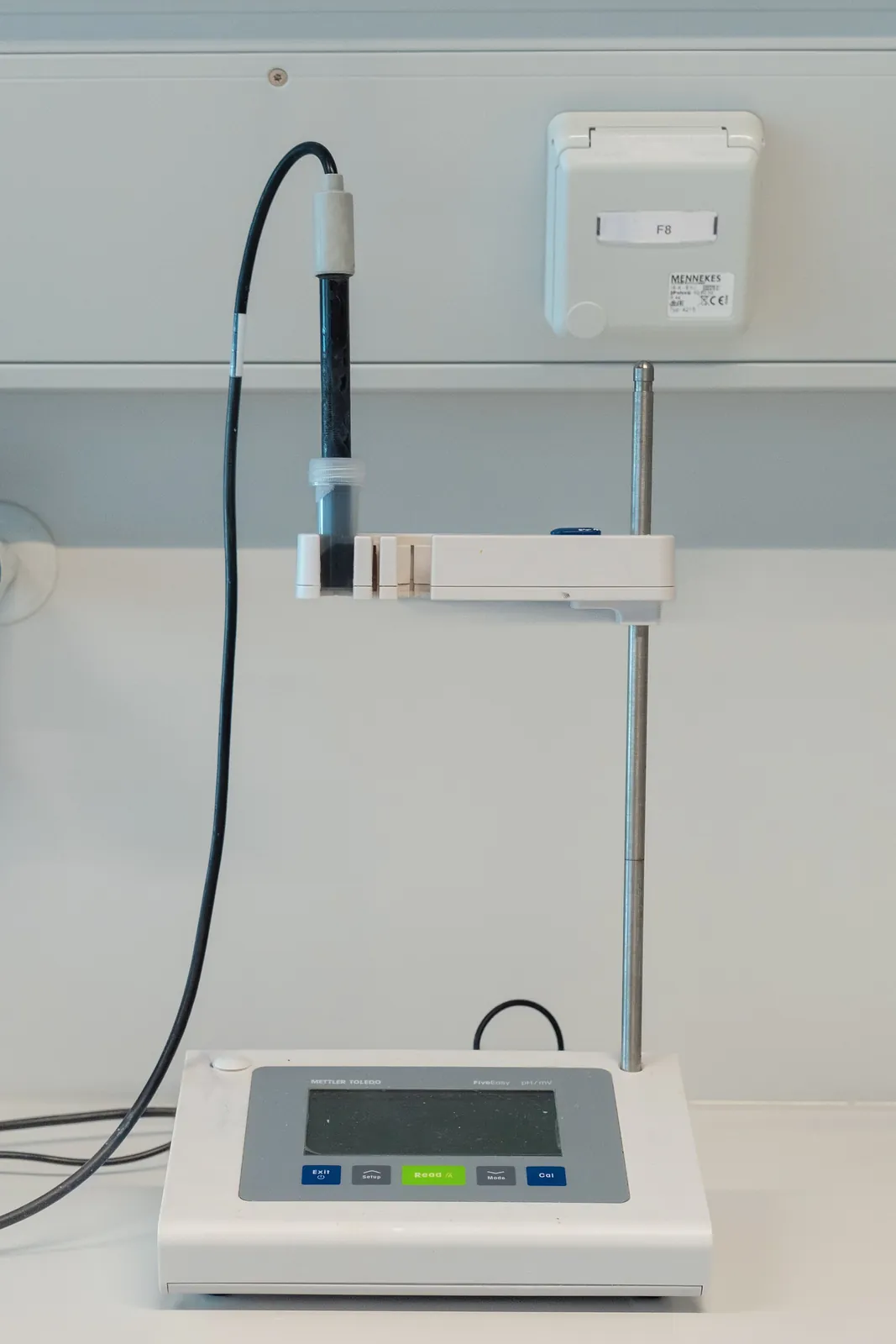
A benchtop pH meter. The glass electrode responds to the hydronium ions in a sample, and the display shows pH to two decimal places. Those two decimal places mean the hydronium concentration has two significant digits.