About 35 min one-to-one, or 40 min with a small group
1. Warm up (5 to 10 min): Ask the quick questions with notes closed.
2. Teach: Work through the lesson slides in order.
3. Coach practice: Use the student examples and try-it tasks.
4. Check: Finish with the outcome prompts below.
Warm-up questions
Is a strong acid the same as a concentrated acid?Listen for: These are different ideas: strength is how fully it ionizes, concentration is how much is dissolved. Listen for whether they separate them.
Vinegar and hydrochloric acid at the same concentration: which reacts faster with chalk?Listen for: Hydrochloric acid, because it is strong. This sets up comparing at equal concentration.
Ethanoic acid has four hydrogen atoms. How many can it donate as acids?Listen for: Only one. This checks whether every hydrogen counts.
What to check they understood
20-C2.10k
Ask them to compare 0.10 mol/L hydrochloric acid and 0.10 mol/L ethanoic acid by pH, conductivity and reaction rate.
A strong answer says hydrochloric acid ionizes completely, so it has a lower pH, higher conductivity and faster reaction with carbonate, while ethanoic acid ionizes only partly.
20-C2.11k
Ask them to show how sulfuric acid gives up its protons in steps.
A strong answer writes a first step making H₃O⁺ and HSO₄⁻ and a second step making H₃O⁺ and SO₄²⁻, and calls sulfuric acid diprotic.
Likely gaps from earlier grades
Students often say an acid with a low pH is strong, even at very different concentrations. Insist on equal concentrations before comparing strength.
Class slides
Work through the class slides
1 / 6
Same concentration, different fizz
At 0.10 mol·L⁻¹, hydrochloric acid ionizes completely and ethanoic acid ionizes only partly.
The hydrochloric acid sample has the lower pH, the faster reaction with carbonate, and the higher conductivity.
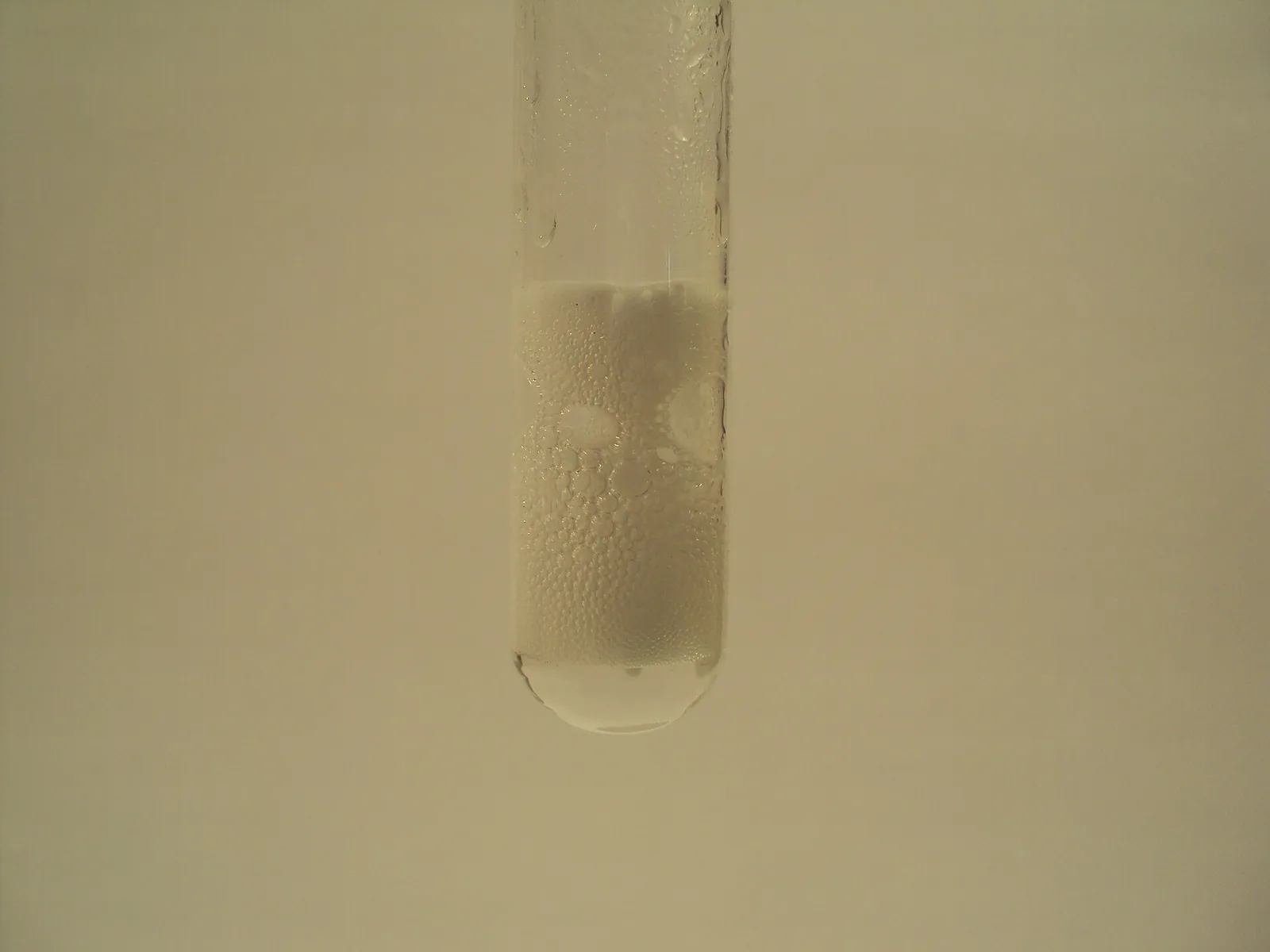
Magnesium reacting with hydrochloric acid. The bubbles are hydrogen gas. A strong acid like HCl ionizes completely, so it has more hydronium ions than a weak acid at the same concentration. The fizzing is faster.