About 35 min one-to-one, or 40 min with a small group
1. Warm up (5 to 10 min): Ask the quick questions with notes closed.
2. Teach: Work through the lesson slides in order.
3. Coach practice: Use the student examples and try-it tasks.
4. Check: Finish with the outcome prompts below.
Warm-up questions
Why do tutors add base one drop at a time near the end of a titration?Listen for: The colour can flip with a single drop. Listen for precision near the end point.
What does an indicator do?Listen for: It changes colour across a certain pH range. This sets up matching an indicator to a titration.
When a strong acid is exactly neutralized by a strong base, what pH do tutors get?Listen for: pH 7. This sets the equivalence point.
What to check they understood
20-D2.5k
Ask them to sketch the titration curve for a strong acid with a strong base and label the equivalence point.
A strong answer draws a curve starting at low pH, rising slowly, then jumping steeply near the equivalence point at pH 7, then levelling at high pH.
20-D2.7k
Ask them to explain the difference between the equivalence point and the end point.
A strong answer says the equivalence point is when the moles of acid and base match, and the end point is when the indicator changes colour, which should be chosen to happen very close to it.
Likely gaps from earlier grades
Students often treat the colour change and the mole match as the same event. Show how a poor indicator choice separates them.
Class slides
Work through the class slides
1 / 6
The colour waits, then flips
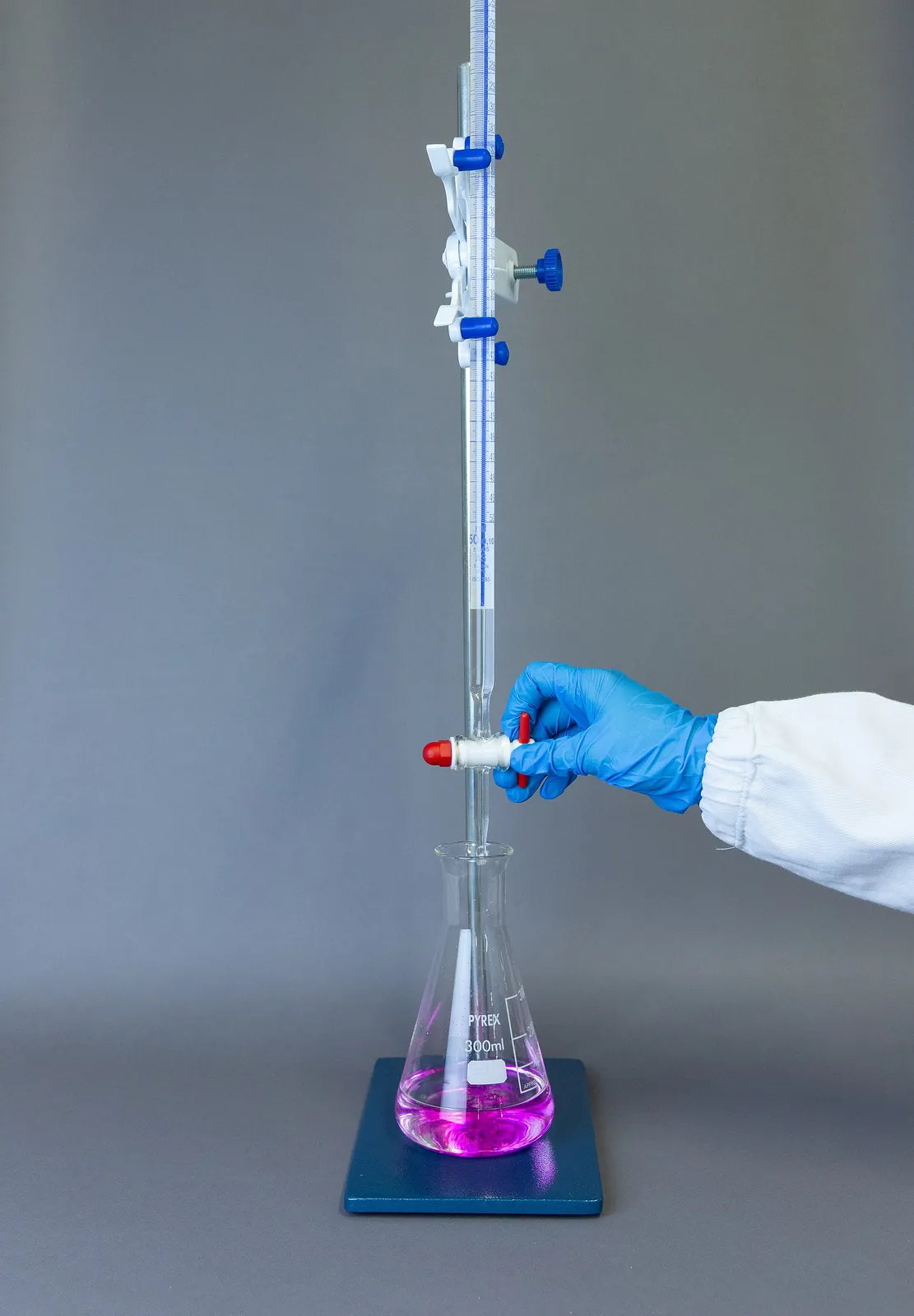
Base can drip into a strong acid for a long volume while the indicator colour barely changes.
Across a few more drops the colour flips, and that flip is a signal on the curve.
A vinegar titration with phenolphthalein. The solution stays colourless while most of the base is added. Near the equivalence point, one more drop of sodium hydroxide raises the pH sharply, and the indicator turns pink.