About 50 min one-to-one, or 65 min with a small group
1. Warm up (5 to 10 min): Ask the quick questions with notes closed.
2. Teach: Work through the lesson slides in order.
3. Coach practice: Use the student examples and try-it tasks.
4. Check: Finish with the outcome prompts below.
Warm-up questions
A shelf label says only copper chloride. Why could that be a problem in a lab?Listen for: Two different compounds could match the label. Any idea about needing a clear name is a good start.
What does the prefix tri mean in a word such as triangle or tricycle?Listen for: Three. This links prefixes they already know to molecular names.
Is sodium a metal or a non-metal, and is oxygen a metal or a non-metal?Listen for: Sodium is a metal and oxygen is a non-metal. Sorting metals from non-metals is the first step in choosing a naming rule.
What to check they understood
A2.2
Ask them to explain why chemists everywhere use one naming system.
A strong answer says one clear name points to exactly one substance, so labs, workers and emergency crews avoid dangerous mix-ups.
A2.4
Ask them to name Na₂SO₄ and P₄O₁₀ and say which naming rule they used for each.
A strong answer gives sodium sulfate using the ionic rule with no prefixes, and tetraphosphorus decoxide using prefixes for two non-metals.
A2.4
Ask them to name FeCl₃ and explain where the Roman numeral comes from.
A strong answer gives iron(III) chloride and works the charge back from three chloride ions at −1 each.
Likely gaps from earlier grades
Ion charges from the last lesson are the base for this one. If they are slow to give Group 1, 2, 16 and 17 charges, review those first.
Roman numerals may be unfamiliar. Check that they can read the numerals one to six.
Class slides
Work through the class slides
1 / 8
An incomplete label
A shelf label that says only “copper chloride” could refer to CuCl or CuCl₂.
The formulas contain different copper-ion charges and identify different compounds.
A systematic name must preserve the evidence needed to identify the intended substance.
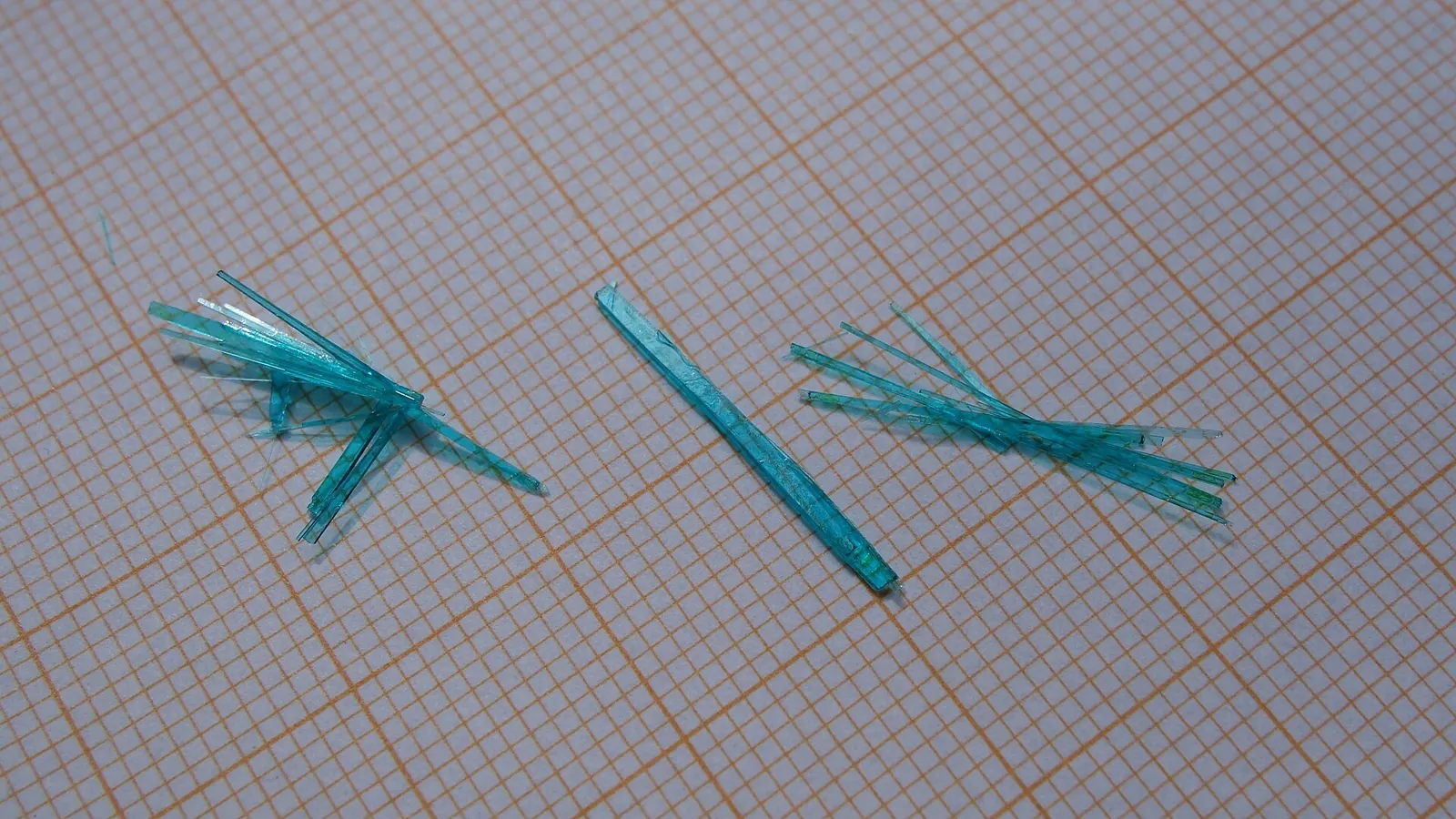
These blue-green needles are copper(II) chloride, CuCl₂, with water held inside the crystal. Copper(I) chloride, CuCl, is a white powder. The Roman numeral in the name tells students which one is on the shelf.