About 50 min one-to-one, or 60 min with a small group
1. Warm up (5 to 10 min): Ask the quick questions with notes closed.
2. Teach: Work through the lesson slides in order.
3. Coach practice: Use the student examples and try-it tasks.
4. Check: Finish with the outcome prompts below.
Warm-up questions
Tutors walk 3 m forward and then 3 m back. How far did tutors walk, and where did tutors end up?Listen for: Six metres of walking but back at the start. This shows whether they already separate distance from displacement.
A car's speedometer reads 60 km/h. Does that tell tutors where the car is going?Listen for: It gives speed only. Direction is missing, which sets up velocity.
What does it mean when a car is speeding up? What about slowing down?Listen for: Speed is changing. Many think acceleration only means getting faster.
What to check they understood
B2.4
Ask them to sort distance, displacement, speed, velocity and time into scalars and vectors.
A strong answer puts displacement and velocity as vectors because they include direction, and distance, speed and time as scalars.
B2.5
Ask them to find the displacement and average velocity of a runner who goes 400 m east and then 100 m west in 100 s.
A strong answer gives 300 m east and 3 m/s east, and shows the direction in both answers.
B2.6
Ask them to calculate the acceleration of a bike that goes from 2 m/s to 8 m/s in 3 s.
A strong answer uses a = Δv/Δt to get 2 m/s² and explains what the units mean.
Likely gaps from earlier grades
Rearranging a simple formula such as v = d/t is often weak. Check it before acceleration problems.
Some students drop units and direction. Ask for both on every answer.
Class slides
Work through the class slides
1 / 5
Distance and displacement on a lap
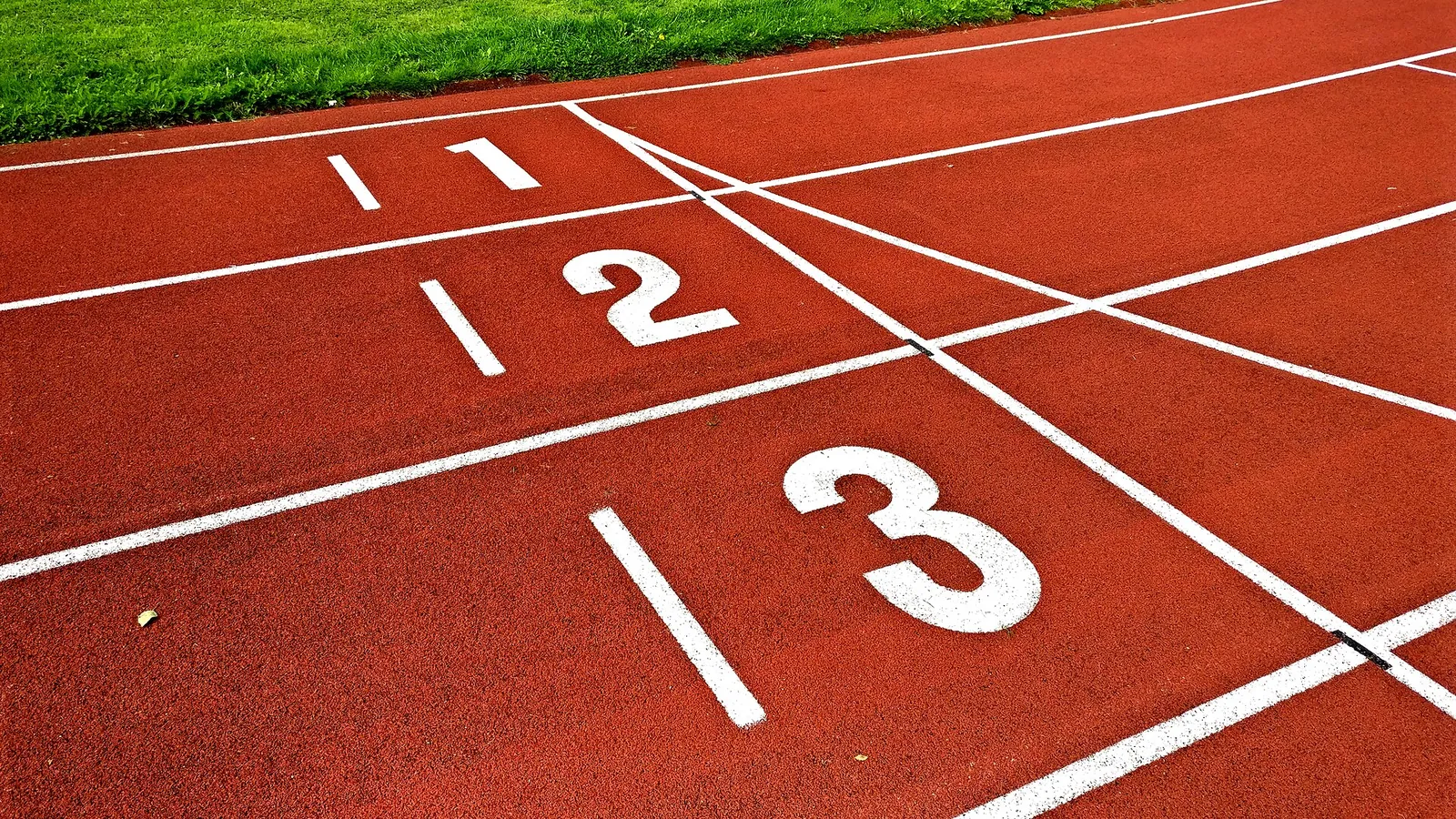
A runner completes 400 m around a track and returns to the starting point.
The distance is 400 m, but the displacement is 0 m because start and finish positions match.
A runner who starts here and finishes here after one lap has covered a distance of 400 m. The displacement is 0 m, because the start and finish positions match.